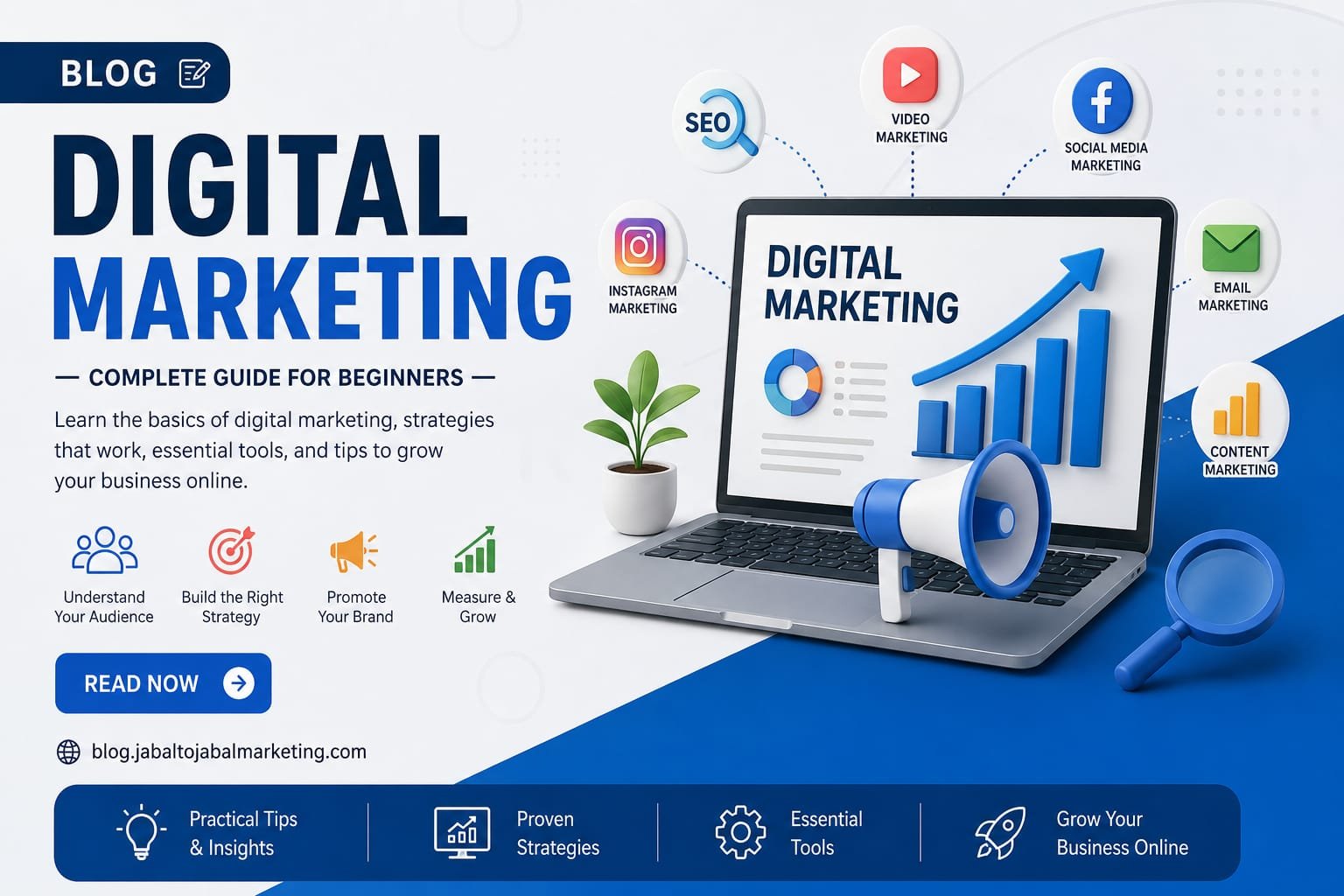
What Is Digital Marketing?
Digital marketing is the process of promoting a business, product, service, or brand through digital channels such as search engines, websites, social media, email, online advertising, and other internet-based platforms.
Unlike traditional marketing, digital marketing allows businesses to reach specific audiences, measure results, test campaigns, and improve their marketing strategies using data.
Whether you run a small local business, an e-commerce store, a personal brand, or a large company, digital marketing can help you attract potential customers and build long-term online visibility.
In this beginner’s guide, you’ll learn the fundamentals of digital marketing and how to create a practical strategy for your business.
Why Is Digital Marketing Important?
People increasingly use the internet to research products, compare services, read reviews, watch videos, and make purchasing decisions.
A strong digital presence allows your business to appear where potential customers are already looking.
Some major benefits include:
- Reach a large potential audience
- Target specific customer groups
- Build brand awareness
- Generate leads
- Increase website traffic
- Promote products and services
- Measure campaign performance
- Improve customer relationships
- Build long-term brand authority
The biggest advantage is measure ability. Instead of simply guessing whether an advertisement worked, businesses can monitor traffic, conversions, engagement, and other performance indicators.
The Main Types of Digital Marketing
Digital marketing isn’t a single technique. It consists of several interconnected channels.
1. Search Engine Optimization (SEO):
SEO is the process of improving a website and its content so that it can appear more prominently in relevant search engine results.
For example, if someone searches:
“best digital marketing agency”
A business that has optimized its website and created useful content may have an opportunity to appear in the search results.
Important areas of SEO include:
- Keyword research
- Helpful content
- On-page SEO
- Technical SEO
- Internal linking
- Website performance
- Structured data
- Digital PR and legitimate link earning
- User experience
SEO is generally a long-term strategy. It can take time to build authority and organic traffic, but successful SEO can provide sustainable visibility.
2. Content Marketing
Additionally, content marketing involves creating and distributing useful content to attract and educate a target audience.
Examples include:
- Blog posts
- Tutorials
- Videos
- Guides
- Case studies
- Infographics
- Podcasts
- E-books
- Checklists
For example, a web-development company could publish:
“How to Create a Business Website: A Beginner’s Guide”
A reader searching for that information may discover the article and later become interested in the company’s services.
Good content should solve a real problem rather than simply exist to attract search-engine traffic.
3. Social Media Marketing
Social media marketing uses platforms such as Facebook, Instagram, LinkedIn, TikTok, and YouTube to build awareness, communicate with audiences, and promote products or services.
A successful social media strategy should not be limited to posting advertisements.
You can publish:
- Educational tips
- Short tutorials
- Customer stories
- Product demonstrations
- Behind-the-scenes content
- Industry news
- Short videos
- Infographics
- Questions and polls
The right platform depends on your audience and business.
4. Email Marketing
Email marketing allows businesses to communicate directly with people who have subscribed to their mailing lists.
Common email campaigns include:
- Welcome emails
- Newsletters
- Product announcements
- Special offers
- Educational content
- Abandoned-cart emails
- Customer follow-ups
The objective shouldn’t simply be to send more emails. The goal is to provide useful and relevant information to subscribers.
5. Pay-Per-Click Advertising (PPC)
PPC advertising allows businesses to pay for advertisements displayed on search engines, websites, social platforms, and other digital channels.
For example, a business might run an advertising campaign for:
“Digital Marketing Services”
When potential customers search for related terms, an advertisement may appear. Paid advertising can generate traffic faster than SEO, but it requires careful budgeting and optimization.
Important PPC metrics include:
- Impressions
- Clicks
- Click-through rate (CTR)
- Cost per click (CPC)
- Conversion rate
- Cost per acquisition (CPA)
- Return on ad spend (ROAS)
6. Affiliate Marketing
Affiliate marketing is a performance-based model in which publishers promote products or services and may receive a commission when qualifying users purchase through their referral.
For example, a technology blog might publish:
“10 Best SEO Tools for Small Businesses”
The article could contain clearly disclosed affiliate links to relevant tools.
Successful affiliate marketing requires genuine value. Simply filling articles with affiliate links is unlikely to create a useful experience.
7. Influencer Marketing
Influencer marketing involves collaborating with creators who have an audience relevant to your product or service.
A business might work with:
- YouTube creators
- Instagram creators
- TikTok creators
- Industry experts
- Bloggers
- Niche content creators
The best partnership isn’t necessarily the one with the largest follower count.
Audience relevance, trust, engagement, and content quality can be more important.
8. Video Marketing
Video has become an important part of modern digital marketing.
Businesses can use videos for:
- Product demonstrations
- Tutorials
- Reviews
- Educational content
- Customer testimonials
- Company introductions
- Short-form social content
A single blog article can also be converted into several pieces of video content.
For example:
Blog:
“How to Improve WordPress Website Speed”
Video:
“10 Ways to Speed Up WordPress”
Short video:
“3 WordPress Speed Mistakes”
This creates a content ecosystem instead of treating every marketing channel separately.
How to Create a Digital Marketing Strategy
A digital marketing strategy gives your marketing activities a clear direction.
Follow these steps.
Step 1: Define Your Business Goal
Start with a specific objective.
For example:
- Increase online sales
- Generate leads
- Increase website traffic
- Build brand awareness
- Grow an email list
- Launch a new product
Avoid vague goals such as:
“I want more customers.”
Instead, create measurable objectives.
For example:
“Generate 100 qualified leads per month through organic search and social media.”
Step 2: Identify Your Target Audience:
You need to understand who you’re trying to reach.
Consider:
- Age range
- Location
- Interests
- Profession
- Problems
- Buying behavior
- Budget
- Preferred platforms
- Search behavior
Create a simple customer profile.
Example
Business: Online clothing store
Target customer: Adults interested in affordable fashion
Problems: Finding good-quality products at reasonable prices
Platforms: Google, Instagram, Facebook, TikTok
This information helps determine where and how you should market.
Step 3: Research Your Competitors
Study businesses competing for the same audience.
Look at:
- Their websites
- Blog content
- Social media
- Search visibility
- Advertising messages
- Product pages
- Customer reviews
- Content formats
Don’t copy competitors.
Instead, identify opportunities to provide something better or different.
Step 4: Choose the Right Marketing Channels
You don’t need to use every platform.
A small business might start with:
SEO + Content Marketing + Facebook/Instagram
An online software company might prioritize:
SEO + Content Marketing + Email Marketing + LinkedIn
An e-commerce business might use:
SEO + Google Ads + Social Media + Email Marketing
Choose channels based on your customers, resources, and goals.
Step 5: Create Valuable Content
Build content around your audience’s questions and problems.
For example, a digital marketing company could create:
Beginner content
- What Is Digital Marketing?
- What Is SEO?
- What Is PPC?
Intermediate content
- How to Build an SEO Strategy
- How to Create a Content Calendar
- How to Measure Marketing Performance
Advanced content
- Technical SEO
- Conversion Rate Optimization
- Marketing attribution
- Advanced PPC optimization
This creates a path for readers to progress from beginner to advanced topics.
Step 6: Build a Conversion Funnel
Getting visitors isn’t enough.
You should give visitors a logical next step.
A simple funnel can look like:
Search Engine
↓
Blog Article
↓
Useful Related Content
↓
Email Signup / Contact Form
↓
Lead
↓
Customer
For an e-commerce business:
Search
↓
Product Guide
↓
Product Page
↓
Add to Cart
↓
Purchase
Step 7: Measure Your Results
Use analytics and reporting tools to understand what is working.
Important metrics include:
Website
- Users
- Sessions
- Page views
- Engagement
- Traffic sources
SEO
- Impressions
- Clicks
- CTR
- Search rankings
- Indexed pages
- Organic traffic
Social Media
- Reach
- Engagement
- Followers
- Video views
- Link clicks
Advertising
- CPC
- CTR
- Conversions
- CPA
- ROAS
Don’t focus on vanity metrics alone.
A post receiving 100,000 views isn’t necessarily better than one that generates 20 qualified customers.
Best Digital Marketing Tools for Beginners
You don’t need dozens of expensive tools when starting.
Google Search Console
Useful for understanding how your website performs in Google Search.
Use it to monitor:
- Search queries
- Impressions
- Clicks
- CTR
- Indexing
- Search performance
Google Analytics
Useful for analyzing website traffic and user behavior.
Google Ads
Useful for paid search and advertising campaigns.
Google Trends
Useful for exploring search-interest patterns and comparing topics.
WordPress
A popular content-management platform for creating websites and blogs.
Canva
Useful for creating social-media graphics, presentations, thumbnails, and other visual content.
AI Writing and Research Tools
AI tools can help with:
- Brainstorming
- Outlining
- Research assistance
- Content ideas
- Summarization
- Editing
- Data analysis
However, AI should support your expertise rather than replace originality, fact-checking, and human judgment.
How AI Is Changing Digital Marketing
Artificial intelligence is becoming increasingly useful across digital marketing.
Businesses can use AI for:
- Content ideation
- Customer-service automation
- Data analysis
- Ad copy variations
- Audience research
- Personalization
- Image generation
- Video creation
- Marketing automation
- Workflow automation
For example, an AI assistant can help a marketer transform one topic into:
- A blog outline
- Social posts
- Video ideas
- Email subject lines
- FAQ questions
But quality control remains essential.
Always review AI-generated information for accuracy, originality, relevance, and brand suitability.
Common Digital Marketing Mistakes
Beginners often make the following mistakes.
1. Trying Every Platform
You don’t need to be everywhere.
Start where your target audience spends time.
2. Focusing Only on Followers
Followers don’t automatically equal customers.
Focus on meaningful business outcomes.
3. Publishing Low-Quality Content
Publishing large quantities of weak content can hurt your overall strategy.
Prioritize useful, original content.
4. Ignoring SEO
Even excellent content can struggle to attract organic visitors if the website has technical or discoverability problems.
5. Not Tracking Conversions
Traffic is useful, but businesses ultimately need results.
Track leads, sales, registrations, downloads, or whatever outcome matters to your business.
6. Expecting Immediate Results
SEO, content marketing, and brand building usually require consistency.
Paid advertising can generate traffic quickly, but profitable campaigns also require testing and optimization.
Simple Digital Marketing Strategy for a Small Business
If you’re completely new, don’t make your strategy complicated.
Start with:
Month 1
- Define your audience
- Build or improve your website
- Create essential business pages
- Set up analytics
- Set up Search Console
- Research competitors
- Create your first 5–10 useful articles
Month 2
- Publish consistently
- Improve existing content
- Start social media distribution
- Build an email list
- Create short-form videos
- Track traffic and conversions
Month 3
- Identify your best-performing content
- Update articles
- Create more content around successful topics
- Test paid advertising if appropriate
- Improve conversion pages
- Start building legitimate industry relationships and mentions
Then repeat the process.
Frequently Asked Questions
Is digital marketing difficult for beginners?
The fundamentals are relatively easy to learn, but becoming highly effective requires practice, testing, analysis, and experience.
How long does digital marketing take to work?
It depends on the channel. Paid advertising can produce traffic quickly, while SEO and content marketing generally require more time to build sustainable results.
Can a small business do digital marketing?
Yes. Small businesses can start with relatively simple strategies such as local SEO, useful content, social media, email marketing, and carefully managed advertising.
Is SEO better than Google Ads?
Neither is universally better. SEO can provide long-term organic visibility, while paid advertising can provide faster exposure. Many businesses benefit from using both strategically.
Can AI replace digital marketers?
AI can automate and accelerate many marketing tasks, but strategy, creativity, customer understanding, judgment, brand positioning, and decision-making remain important human responsibilities.
How much does digital marketing cost?
There is no single price. Costs depend on your objectives, industry, advertising budget, tools, content requirements, and whether work is performed in-house or by an agency.
Final Thoughts
Digital marketing is not about using every available platform. It is about reaching the right audience with the right message through the right channels and measuring whether your efforts produce meaningful results.
If you’re a beginner, start small:
Understand your audience → Create useful content → Build your online presence → Choose the right channels → Measure results → Improve continuously.
The most successful digital marketing strategies are rarely built overnight. They develop through consistent publishing, experimentation, analysis, and improvement.
Jabal to Jabal Marketing is committed to sharing practical insights, strategies, and ideas to help businesses navigate the digital world and grow online.
Start Your Digital Marketing Journey
Want to learn more?
Explore our upcoming guides on:
- How to Create a Digital Marketing Strategy
- Best Digital Marketing Tools
- Complete SEO Guide for Beginners
- How to Grow a Business with Social Media Marketing
- AI Tools for Digital Marketing
- Content Marketing Strategy for Small Businesses
- Google Ads Guide for Beginners
- E-commerce Marketing Guide